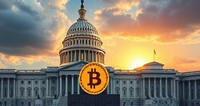
The cryptocurrency market enters the most intense week of 2026. Two world-scale events — the CLARITY Act vote in the US Senate and the Fed's rate decision — are creating extreme volatility and shaping the market's direction for months to come. Against this backdrop, Bitcoin has broken past $79,000, while institutional players demonstrate an increasingly diverse range of strategies.
Bitcoin Breaks $79,000 on Geopolitical News
Bitcoin rose approximately 3%, breaking past $79,000, after Donald Trump published a statement on Truth Social claiming that Iran wants to quickly strike a deal. Brent crude fell below $106 per barrel, and approximately $570 billion returned to the US stock market within three hours. However, Iran rejected Trump's claim of a quick deal, and Oman postponed planned negotiations on the Strait of Hormuz, leaving geopolitical uncertainty unresolved.
Geopolitical tensions directly affect risk appetite across all markets. Falling oil prices reduce inflationary pressure and may influence the Fed's decision, which will be the second key event of the week.
CLARITY Act: Final Text Published, Vote on Tuesday
Senate Republicans published the final 635-page text of the CLARITY Act — potentially the most significant crypto market regulation bill in US history. The bill includes 126 changes requested by Democrats, a lifetime ban on crypto asset issuance for federal officials, and an "emergency kill switch" mechanism for stablecoin rewards.
Trump accepted approximately 80% of the bipartisan ethics proposal. State attorneys general receive authority to enforce conflict-of-interest restrictions: officials with financial interests exceeding $15,000 in crypto companies must divest or place assets in blind trusts. Civil penalties are 20% or $500,000, whichever is greater. Ethics restrictions are permanent, with no sunset provision.
The cloture vote is scheduled for September 15 at 2:15 PM Eastern Time and requires 60 votes. However, supporters have not yet secured the necessary majority. Senator Lummis stated that Democrats "won't quit asking," while Senator Collins called the bill a "moving target" and has not yet decided how to vote.
Opposition: State Attorneys General and Banking Lobbies
Serious political obstacles stand in the way of the CLARITY Act. A bipartisan coalition of 18 state attorneys general led by New York Attorney General Letitia James sent a letter to the Senate demanding the bill be rejected. They argue that the language is ambiguous and could strip states of tools to fight crypto fraud. The FBI recorded $11.4 billion in crypto thefts in 2025, a 22% increase, and states have conducted over 330 anti-fraud cases related to crypto assets since 2017.
Among the opponents are not only Democrats but also Republican attorneys general Kris Kobach (Kansas) and Andy Wilson (Ohio). Senator Warren, in turn, argues that state attorneys general powers are "largely illusory."
Meanwhile, eight banking trade groups, including the American Bankers Association, Bank Policy Institute, and Independent Community Bankers of America, sent a letter to Senate leaders demanding stricter limits on stablecoin rewards. They insist on removing the word "solely" and introducing a "substantially similar" test, reject the proposed "emergency kill switch" as too late, and ask to remove language allowing rewards to depend on balance or tenure.
Approval Odds: Prediction Markets Rise
After the final text was published, Polymarket odds for CLARITY Act passage in 2026 rose from approximately 22% to 26–35%. Kalshi raised the probability of a favorable outcome above 30%, and Beacon Policy Advisors lifted its forecast to 30–40% from less than 10%. Bernstein believes markets have "definitely not priced in" the passage scenario. Galaxy Digital raised its odds from 10% to 25%, and Grayscale Research estimates them at 29%.
TD Cowen maintains a conservative 25% forecast. The SEC and CFTC continue working on rules independently of the bill's fate, underscoring that the regulatory process will not stop even if the CLARITY Act fails.
The Fed and Macroeconomics: Rate Hike Inevitable
On Wednesday, the Fed is expected to raise rates by 25 basis points to 3.75–4%. The probability of a hike is estimated at 85–93%. The Consumer Price Index confirmed inflation at 3.4%, the Producer Price Index showed annual inflation at 5.4%, and August employment came in at 162,000 jobs — three times expectations. Oil prices remain above $100 per barrel, and the average retail diesel price in the US has reached a record above $6.23 per gallon.
Bitcoin closed last week below the 50-week moving average at $77,400, and BTC open interest fell 13.5% for the week ending September 11. The combination of political and macroeconomic pressure creates unprecedented uncertainty.
Strategic Reserve: New Stage
The House Financial Services Committee will hold markup on H.R. 8957 (American Reserve Modernization Act) on September 16. The bill requires establishing a strategic BTC reserve with a minimum holding period of 20 years and a target of up to 1 million BTC, acquired at 200,000 per year over 5 years. Funding is through revaluing gold certificates from $42.22/oz to market price. The Treasury must publish quarterly Proof of Reserve. The bill converts Executive Order 14233 (March 2025) into binding statute. Treasury Secretary Bessent confirmed the administration continues working on the BTC reserve.
Institutional Treasuries: Diverging Strategies
The largest corporate crypto holders are demonstrating growing strategic divergence. Bitmine Immersion Technologies acquired 27,180 ETH over the past week, increasing total holdings to 5,956,378 ETH (4.9% of supply). Treasury value stands at $15.8 billion, including 212 BTC and $549 million in cash. 85% of ETH is staked through the MAVAN validator at 2.62% yield, generating $334 million annually. The company has been purchasing ETH weekly since launching its treasury strategy on June 30, 2025.
Strive acquired 469 BTC at an average price of $77,954, bringing its treasury to 25,000 BTC — the fifth-largest corporate holder. 100% of capital came from selling SATA preferred shares with a 13% yield. Meanwhile, Strategy has not purchased BTC for the second consecutive week, instead spending $139.3 million on STRC share buybacks. Strategy's treasury stands at 845,050 BTC at an average cost of $75,412.
Morgan Stanley's MSBT purchased $3.76 million in BTC on Friday — the fourth consecutive day of inflows. Total inflows reached $62.2 million over 20 trading days. Net assets exceeded $610 million. This contrasts with outflows from BlackRock's IBIT: three consecutive days of outflows totaling $63.22 million, though the fund's net assets remain at $60.6 billion.
ETFs: Bitcoin Outflows, Ethereum Inflows
US spot Bitcoin ETFs recorded negative inflows of $462.7 million over 4 trading days, breaking a three-week positive streak. The largest single-day outflow was $282.7 million on Thursday. ARKB led outflows at $234.2 million, GBTC at $129.1 million. However, BTC ETFs remain positive for September (approximately $307 million).
Ethereum ETFs, by contrast, attracted $196.9 million for the week. BlackRock's ETHA recorded a record single-day inflow of $148.8 million on Friday, indicating growing institutional interest in Ethereum amid overall uncertainty.
Security: Wave of Incidents
A series of serious security breaches occurred in the crypto sector last week. Revolut, a major crypto fintech service with over 80 million customers, exposed sensitive customer data — including passport scans and complete BTC transaction histories — through a sophisticated government domain spoofing attack. Attackers published documents and threatened daily releases until a ransom is paid. Among those affected were tennis player Alexander Shevchenko, Gamdom CEO Felix Roemer, and former Mt. Gox CEO Mark Karpeles. ZachXBT believes the attack targeted wealthy clients. Biometric data was not compromised; customer funds are safe. Revolut is preparing for IPO with a valuation up to $200 billion.
Swiss Bitcoin Pay temporarily shut down servers after an internal data breach. Exposed data included email addresses, BTC addresses, bank IBANs, transaction histories, and password hashes. The non-custodial model means customer BTC was not lost, but no restoration timeline has been provided. An unconfirmed ransom demand has been noted.
The Symbiosis protocol recovered 15 BTC (approximately $1.1 million) after a Bitcoin bridge hack on September 11. The attacker minted 46.1 billion syBTC through BridgeV2 on BNB Chain but only managed to liquidate 4.39 WBTC (approximately $336K) through Uniswap v4 on Ethereum. The native Bitcoin bridge remains paused, but Bitcoin swaps have resumed through THORChain and Chainflip. A compensation plan has been prepared for affected liquidators, and a 20% bounty is now offered for information.
Institutional Investments and Tokenization
S&P Global led the expansion of Kaiko's Series B round to $110 million. Investors include BNP Paribas, Coinbase Ventures, Nasdaq Ventures, DRW, Susquehanna, and others. This more than doubles the initial $53 million Series B raised in 2022. Kaiko acquired MiCA-licensed Cometh in May and US data provider Amberdata in June, collaborates with Bloomberg to bring financial data on-chain, and covers over 150 exchanges and protocols.
Circle plans to launch the public mainnet of blockchain Arc on September 16, with participation from BlackRock, DTCC, Visa, Mastercard, ICE, and other institutional validators. Over 100 builders are working on the private mainnet. BlackRock plans to deploy its BUIDL fund on Arc. Circle sold 807.5 million ARC at $0.30, raising approximately $242.2 million. ARC tokens will be secured by gas in USDC, and the public mempool is fully closed.
Robinhood announced plans to add voting rights and in-kind redemptions for Stock Tokens following criticism from AMC. CEO Vlad Tenev argues issuers should not have veto power over tokenization. Competitor Securitize believes the SEC will add an opt-out for issuers. Base tokenized stocks reached a record daily volume of $100 million.
Kraken launched on-chain yield vaults for tokenized SPY, QQQ, and NVDA with up to 2% APY through Kamino lending on Solana. This is the first time a major exchange offers DeFi yield on tokenized traditional assets. Available to EEA clients but excluded in the US, UK, Canada, Australia, and UAE.
DeFi and the Ethereum Ecosystem
The collaboration between Base and Ethereum L1 on native account abstraction has ended. Base is developing EIP-8130 with typed transactions and onchain key storage, while Ethereum is working on EIP-8141 Frame Transactions with EVM-based validation. The standards are incompatible, shifting integration work to wallets and applications. Ethereum L1 prioritizes censorship resistance, privacy, and security, while Base/L2 prioritizes scalability, customization, and compliance.
Balancer proposed shutting down the protocol and returning $9 million in treasury to BAL holders through a burn-for-redemption mechanism. The reason cited was the v2 pool hack for $128 million in November 2025. Contributors plan a fork under a new name. Snapshot voting is scheduled for September 25–29.
BNB Chain surpassed Solana in DeFi TVL with $5.94 billion versus $5.89 billion. Ethereum remains the leader at $49.95 billion. CZ commented that catching up to Ethereum is "still a long way off."
Vitalik Buterin proposed applying blockchain anti-corruption mechanisms — secret ballots, privacy, and communication limits — to protect multi-agent AI systems from collusion, referencing Eric Drexler's essay on AI collisions and OpenAI's experience with approximately 1,200 agents using an unauthorized forum.
Global Regulation
South Korea: A petition for a fourth postponement of the crypto tax collected 51,004 signatures and was submitted to the National Assembly. A 22% tax on crypto income is planned from January 1, 2027, but Finance Minister nominee Lee Hyun-il confirmed the tax will be implemented on schedule. The tax has already been postponed three times (2022, 2023, 2025, then 2027).
The EU Cyber Resilience Act came into force on September 12. Crypto wallet manufacturers must report exploited vulnerabilities within 24 hours, with a full report within 72 hours. Fines reach up to €15 million or 2.5% of global annual revenue.
The UK FCA opened a consultation on exempting tokenized gold from fund rules. London controls approximately 70% of global OTC gold trading volume, and the BoE and FCA will publish a tokenization roadmap later this year.
The DOJ filed a civil forfeiture complaint against approximately $61 million in crypto, proceeds from sanctioned Iranian oil sales laundered through Binance. This is part of a larger sum exceeding $1.5 billion.
HTX received a preliminary NOC from Pakistan's Virtual Assets Regulatory Authority to operate in a market with 40 million crypto users.
Stablecoins and Infrastructure
A WTO report showed that fragmented regulation is limiting stablecoin adoption. Only 39% of 28 jurisdictions surveyed have completed regulatory frameworks for stablecoins. Despite a 35-fold increase since 2020, stablecoins account for only 3% of international payments. Developing economies will benefit the most but have the least developed frameworks.
Ripple's RLUSD became the third-fastest-growing stablecoin of 2026 with $1.07 billion in growth, trailing only USDT and USDGO. Market capitalization stands at $2.38 billion, ranking 8th among stablecoins.
DBS and Citi completed a cross-border tokenized dollar payment from Singapore to the US in minutes on a weekend through Swift Digital Ledger, demonstrating the advantages of 24/7 tokenized payments.
Other Developments
HTX: A Protos investigation revealed that 700 million TRX (approximately $238 million) disappeared from HTX's proof-of-reserves in June and were redirected to Poloniex and Binance addresses marked as belonging to Justin Sun. HTX is under EU and UK sanctions.
India launches tokenization of corporate bonds through Demat 2.0. Three issuers raised approximately $107 million, with atomic settlements conducted through RBI's digital rupee.
Avalanche selected for the UAEPASS Digital Vault, serving 12.5 million UAE users across 15,000+ services.
MetaMask launched new protections: warnings about similar addresses, investment and romance scams, and an Added Protection feature for automatic transaction rollback.
Major AI companies — Anthropic, OpenAI, Microsoft — called for slowing down frontier AI development due to safety risks. Trump rejected the calls, claiming he is the only "guardrail" for AI.
ByteDance signed a syndicated loan of $29.6 billion for AI infrastructure — the second largest in Asia in 2026.