
Crypto markets moved higher on Tuesday, with total market capitalization rising 1.68% to $2.78 trillion. Bitcoin traded near $83,195, up 1.57%, while Ether changed hands around $2,463, up 2.90%. Zcash led the advance with an 8.5% gain.
Sentiment remained neutral, with the Fear and Greed Index at 51. The macro backdrop was less comfortable: the yield on 10-year U.S. Treasuries stayed above 5%, Brent crude traded near $110, and the Federal Reserve is scheduled to meet on October 27-28. Even so, institutional demand provided support, as U.S. spot bitcoin ETFs attracted $526.7 million on Monday, their best day in nearly a month.
The day’s news reinforced two parallel trends: traditional finance is building more regulated routes into crypto, while regulators and courts are still defining how those routes will work. JPMorgan’s first long-term bitcoin forecast and Switzerland’s approval of a retail bitcoin fund underscored the first trend. France’s stablecoin tax debate, a fight over perpetual futures in the United States and a dispute over tokenized equities illustrated the second.
Bitcoin ETFs regain momentum
U.S. spot bitcoin ETFs drew a net $526.6 million to $526.7 million on October 19, the strongest inflow since September 22, according to Decrypt and Brave New Coin. BlackRock’s IBIT accounted for almost the entire total with $665.2 million, making it the only one of 12 funds with a net inflow. Fidelity’s FBTC lost $83.6 million, while Grayscale’s GBTC lost $54.9 million.
The inflow cut October’s net outflow for bitcoin ETFs from about $615 million to roughly $88 million, or $90.6 million by another estimate. The rebound was narrower than the headline number: spot ether ETFs lost $103 million, including $95.4 million from BlackRock’s ETHA, and Solana ETFs lost $6.7 million. The concentration in IBIT shows that institutional demand is returning, but it is not yet broad-based.
J.P. Morgan Asset Management gave bitcoin its first return forecast in the 31st edition of its 2027 Long-Term Capital Market Assumptions, published October 19. The bank projected about 10% annualized compound returns over 10 to 15 years, above its 7.5% estimate for large U.S. equities, 8.2% for REITs and 5.5% for gold, according to Decrypt.
JPMorgan estimated bitcoin’s volatility at roughly 55% and put its arithmetic average return at 20.9%. Its bull case assumes 16.6% annualized, while the bear case implies a loss of 11.2% a year. The bank did not add bitcoin to its core strategic portfolio covariance matrices because of its volatility and unstable correlations.
The forecast is notable because it comes from a major bank that remains cautious about putting bitcoin into model portfolios. It strengthens the institutional case for BTC without endorsing a blanket allocation.
BlackRock also filed with the SEC on October 19 for the iShares Bitcoin Managed Protection ETF, ticker PBIT, a product designed to limit initial losses to about 10% before fees in exchange for capped upside. The fund would not hold bitcoin directly; it would use call options on IBIT and fixed-income instruments. Protection is structured through three overlapping tranches offset by one month, according to Decrypt.
The filing used Form 485APOS. Fees, the upside cap and the listing exchange were not disclosed, and the SEC has not approved the product. The stated effective date is around January 2, 2027, but that is not a launch date. The proposal signals that issuers are moving beyond plain exposure toward risk-managed bitcoin products aimed at more conservative investors.
Corporate treasuries keep accumulating
Strive disclosed purchases of 1,223 BTC between October 14 and 16 at an average price of about $81,734, taking its holdings to 36,818 BTC, NewsBTC reported. Super League shareholders approved Metaplanet’s contribution of 2,100 BTC, worth about $170 million, plus $2.5 million in cash into a new U.S. entity.
Metaplanet is expected to hold about 95.7% of the company, which would be renamed Superplanet with the ticker SUPA. The deal is expected to close in the fourth quarter of 2026, subject to Nasdaq and regulatory approvals.
On the supply side, the Mt. Gox trustee postponed creditor repayments to October 31, 2027, the fourth annual extension. Base, early lump-sum and intermediate payments are largely complete for creditors who finished the required procedures, but many have not. About 34,388 BTC worth roughly $2.8 billion remained in linked wallets, according to Arkham data cited by Decrypt. The delay reduces the risk of a sudden wave of creditor selling.
Europe opens more regulated gateways
Switzerland’s FINMA approved the country’s first retail fund that invests directly in bitcoin on October 20. The regulator waived standard risk-diversification rules for the fund, citing bitcoin’s long trading history and high volumes. The vehicle is classified as an other fund for alternative investments with special risk, according to Decrypt.
The fund’s name, issuer, ticker, fees, custodian and launch date were not disclosed. The approval relies on FINMA’s January 12, 2026 guidance on bankruptcy-protected custody of crypto assets. Switzerland approved the Crypto Market Index Fund in 2021, but only for qualified investors. Media reports named BIT Asset Management, formerly Matrixport Asset Management, as a likely issuer, but neither the regulator nor the company confirmed that.
Germany’s Sparkassen-Finanzgruppe launched crypto trading at five savings banks on October 19 and lifted an informal ban on such services. Clients can trade BTC, ETH, XRP, Solana and Polygon through an existing banking app. DekaBank provides the trading infrastructure, while Boerse Stuttgart Digital acts as custodian; DekaBank holds MiCA authorization, according to U.Today and Crypto News Flash.
More than 230 banks have expressed interest, and DSGV expects 30 to 40 to connect each month. The fee is €0.99 per order plus a spread, with a maximum order of €250,000. Clients cannot transfer coins to their own wallets, only to four approved providers. The rollout brings major altcoins into mainstream bank apps, but it remains a walled-garden model.
In Russia, Sberbank received authorization to operate a crypto exchange and plans to launch in December, offering bitcoin, ether and USDT through existing applications. Non-qualified investors will face testing and purchase limits, The Defiant reported.
Regulators draw new lines around trading and taxes
France’s National Assembly adopted a budget amendment by a single vote, 38 to 37 with 25 abstentions, that would make swaps from crypto into MiCA-regulated stablecoins a taxable sale from January 1, 2027. Gains would face a flat 31.4% tax, and cost basis would shift from a portfolio-wide method to an asset-by-asset method, according to Decrypt.
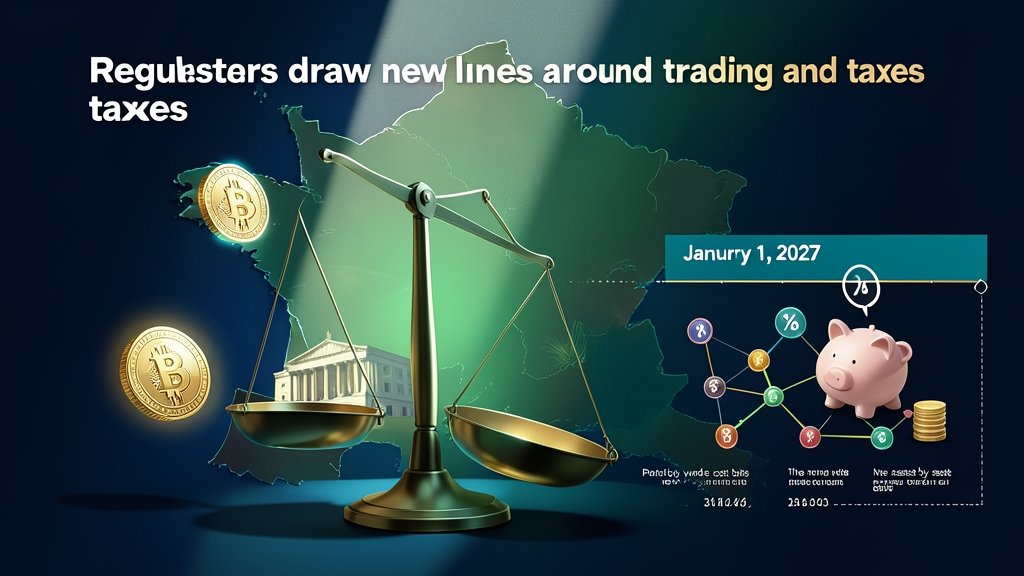
The government opposed the measure, arguing that stablecoins need a legal definition. A separate amendment would require taxpayers to declare self-custodied crypto above €100,000, with fines of up to €10,000. The Defiant reported that a budget vote was moved to November 3, and no measure has become law. If enacted, the rule would make France one of the first EU countries to tax stablecoin conversions, affecting a common way to lock in gains without leaving crypto.
In the United States, the CFTC asked a federal judge to dismiss CME Group’s lawsuit over Kalshi’s U.S. perpetual futures, arguing that CME lacks standing. CME is challenging the CFTC’s May 29 approval of Kalshi’s bitcoin perpetual as a futures contract, contending that perpetuals are swaps. The CFTC noted that CME’s monthly crypto futures volume rose from about 2.66 million contracts in May to 3.28 million in September, Bankless reported. Judge Colleen Kollar-Kotelly will decide whether the case survives.
The Hyperliquid Policy Center sent comments to the SEC on October 19 asking for five changes to the proposed Regulation Crypto Assets: rules for airdrops, trading after an exempt distribution, a safe harbour, token buybacks and consistency between federal and state rules. The document is a rulemaking comment, not a regulatory decision, NewsBTC reported.
A separate dispute is testing the market for tokenized equities. The number of companies objecting to trading of their shares on OKXICE TSV rose from nine to sixteen, with Microsoft, Alphabet, Goldman Sachs, Qualcomm, Caterpillar, McDonald’s and Western Digital joining the list. The updated notice was dated October 19, but it did not explain the objections or say whether they block listings, according to Decrypt.
OKXICE is being built by OKX and NYSE owner Intercontinental Exchange and plans 24/7 trading on Uniswap v4 in XLayer, with settlement in USDC and USDT under an SEC innovation exception. It is not registered with the SEC and is not subject to Regulation NMS. Nasdaq plans to exclude its own shares from the venue, citing the lack of real-time prices and reporting to a consolidated tape. The standoff could set an important precedent for whether tokenized shares can trade without issuer consent.
Index rules are also creating pressure. MSCI finalized a rule on October 15 that will exclude non-operating companies whose balance sheets are dominated by a single asset from its Global Investible Market Indexes, effective at the close on November 30, 2026. The list of affected companies will be published on November 11. Strategy, the largest public bitcoin treasury company, holds 848,517 BTC bought for $64.02 billion at an average price of $75,446; at about $82,500, the stake is worth roughly $70.3 billion, or $6.3 billion above cost, according to Decrypt. Separately, Protos noted that Strategy’s STRC has traded below its $100 par value since May 15 despite repeated buybacks.
Security concerns intensify
Wallets linked to the Drift Protocol exploit moved between 13,400 and 25,700 ETH into Tornado Cash, with sources giving different dollar estimates: about $61.5 million from Decrypt and MistTrack, $54.8 million from The Defiant and $32 million from U.Today. The transfers were made in batches of 100 ETH and smaller blocks of 10 ETH.
Arkham data showed that addresses tied to the attacker still held 81,454 to 84,164 ETH, worth about $200 million to $224 million. The April 1 attack drained Drift on Solana. TRM Labs and Chainalysis linked it to North Korea’s UNC4736, also known as Citrine Sleet, while Mandiant attributed it to UNC6862. It was the second major laundering attempt after about $44 million was moved through the mixer in July, according to Decrypt and The Defiant.
A Blockaid study found that stablecoin issuer blocklists recovered no money in 60 crypto exploits between January and August. Of $1.18 billion in tracked funds, victims recovered $9.8 million, and every dollar frozen or returned came through governance or validator action rather than issuer blacklists, The Defiant reported. The finding challenges the idea that blacklists are a reliable recovery tool.
Liquid said bitcoin swaps had been restored, but L-BTC peg-outs remained frozen. Reserves covered about 85.8% of issued L-BTC, leaving a deficit of roughly 603 BTC, according to The Defiant.
Separately, blockchain investigator ZachXBT alleged that FreedomXMR, a Monero exchange service on Hyperliquid Core, received more than 87% of its incoming funds from illegal activity, with more than $20 million traced to ransomware, exploits and social engineering. The report, covered by Bankless, linked sources to the DCENT Wallet, Fetch.ai and Axelar exploits in September, a ransomware payment and the Gamdom exploit in October. Hyperliquid had not publicly responded.
The service appeared on Hyperliquid Core in August, and its administrator obtained XMR liquidity from KuCoin through more than 3,000 deposits. XMR rose about 73% from August 1 to around $620. These claims are allegations from a private investigation and have not been confirmed by Hyperliquid. They nevertheless add a reputational risk for venues that list privacy-focused exchange services.
Ethereum supply tightens as upgrades advance
Bitmine Immersion Technologies said it held 6,041,481 ETH as of October 18 after buying another 12,535 ETH in the previous week. The company estimates its stake at about 4.9% of Ethereum’s circulating supply, with more than 5 million ETH staked. Its combined crypto assets, cash and investments were worth about $15.1 billion, NewsBTC reported.
Ethereum staking reached a record 43.8 million ETH, according to Bitwise, even as gross annual staking yield fell to 2.63% from 2.81%. Solana also recorded more staked tokens at a lower yield, The Defiant reported. Record staking reduces free float, but declining yields may temper the incentive to add validators.
The Ethereum Foundation confirmed that the Glamsterdam upgrade will activate on the Hoodi testnet on October 26, with the gas limit rising to 200 million. The upgrade is already active on Sepolia with the same limit, and no mainnet date has been set. Glamsterdam includes EIP-7732 on proposer-builder separation, EIP-7928 on block-level access lists and EIP-8037/8038 on gas repricing, Crypto News Flash reported. Activation is scheduled for epoch 132,352, slot 4,235,264.
Stablecoin payments scale as AI agents get a payment rail
Stablecoin payment volume reached $482 billion in the first nine months of 2026, up 45% year over year, according to an Allium report for the third quarter. The number of payments rose 71% to 1.04 billion, while the average payment fell from $544 to $462. Stablecoin supply stood at about $305 billion at the end of September, Altcoin Buzz reported.

Tron processed two-thirds of the payment value, and USDT accounted for 84%. September volume reached a monthly high of $72 billion. Falling ticket sizes alongside rising volume point to broader, smaller-scale use rather than a few large transfers.
Mastercard opened early access to Agent Pay for Machines, a system that lets AI agents find services, agree on terms and pay within set limits. A live demonstration took place at Cloudflare Connect. The system uses the x402 protocol and signed payment vouchers; Coinbase provides the wallet, Base is the settlement network, and final settlement occurs in fiat or stablecoins through BVNK and Mastercard’s Global Money Platform, according to Decrypt.
In the demonstration, an agent ran a campaign through nine payments to two sellers within one budget. Mastercard is releasing APIs for buyers and sellers, tools and a sandbox. The company acquired BVNK in August. The move makes stablecoins and x402 part of the plumbing for machine-to-machine commerce.
Quantum-ready upgrades move from theory to testnets
Stellar announced the Bell upgrade, also known as Protocol 30, with a new address format, millisecond timing and post-quantum signatures. A final validator vote is scheduled for November 23, 2026. CAP-84 introduces W-addresses and multiplexing for smart contracts, CAP-88 moves system clocks to milliseconds, and CAP-87 integrates the ML-DSA post-quantum standard, U.Today reported.
Infrastructure providers, wallets and exchanges that do not update their SDKs by November 23 will lose the ability to recognize new ledger blocks. For XLM holders, the upgrade will work as a normal hard fork with no manual migration.
Tron DAO deployed support for post-quantum signatures on the Nile testnet. TIP-899 adds Falcon-512 and Dilithium2 at the protocol level for transactions, block production, relay connections and the Tron Virtual Machine, though the algorithms are disabled by default and would require separate governance proposals. The proposal notes that more than 6.9 million BTC sit on addresses with exposed public keys.
Starknet began a seven-day, non-binding poll on whether to become an independent post-quantum Layer 1. STRK would remain the token and bridges from Ethereum would be preserved. Bitcoin’s BIP-360 remains a draft, while Coinbase has urged the industry to prepare for migration, according to Altcoin Buzz. The efforts show that quantum readiness is becoming an engineering roadmap rather than a distant thought experiment.
What to watch
The market enters the rest of the week with a clearer institutional bid but no shortage of unresolved risks. Bitcoin ETF flows will need to broaden beyond IBIT to confirm a durable turn. In Europe, the Swiss retail fund’s eventual terms and the pace of Sparkassen’s rollout will show how quickly regulated access reaches ordinary investors.
Policy remains the main swing factor. France’s budget vote is now set for November 3, MSCI will publish its affected-company list on November 11, and the CFTC-CME dispute could determine the legal status of U.S. perpetual futures. Ethereum’s Hoodi test on October 26 and Stellar’s validator vote on November 23 will provide the next technical milestones. For now, institutional adoption and regulatory clarification are advancing together, but not always in the same direction.